Washington Irving: Rip Van Winkle
 "The great error in Rip's composition was an insuperable aversion to all kinds of profitable labour."
The main character of Washington Irving's Rip Van Winkle is described by the fictional "narrator" Deidrich Knickerbocker.
Is it really such an "error" to have an aversion to all kinds profitable labour? Don't we all? I'm only slightly joking, of course. The narrator goes on to say that Rip is not necessarily lazy... He does plenty of things which require patience and perseverance, and he regularly helps other people. If I ventured to compare him to myself, I'd have to say I often lack the drive and energy to do my job at the hospital, but when it comes to something I'm passionate about, I'm happy to work into the wee hours of the night, and find within myself a fresh bundle of energy.
When a person is in an unhappy situation, it makes sense he'd want to resist. The poor man had a nagging wife, and a farm that didn't thrive even if he did work on it... And there's talk of disheveled children. Back then, wasn't it the wife's duty to raise the children? So maybe she wasn't doing her job either. In today's world, if a person is in an unhappy marriage, and at an unhappy job, he or she may have the power to divorce, and perhaps to seek out a new career. Then again, I suppose one only has these opportunities if they're lucky enough to have been born into the right social class.

I'm thinking what I should've written about here is the difference between hearing this story as a kid, and reading it now. Back then, it was a kid's fairy tale, just as I suppose Poe stories were merely scary stories. Now here I am at age 32, trying to figure out what kind of social or political message it has... and I honestly don't know yet. I think I should go read it again. :-)
Something interesting I did find online at this website is the fact that Irving later added a post-script to Rip Van Winkle, after the original final note, which tells stories of Native American ghosts, etc. “In 1848, Irving added a “postscript” to the end of “Rip Van Winkle,” after the “Note.” The added section, which is omitted from many editions of the story today, describes several Native American traditional stories about ghosts and spirits in the Catskill region, a reinforcement of the sense of ancient mystery that Irving tried to capture in the story.”
I'd like to get my hands (eyes) on that post-script.
Henry David Thoreau
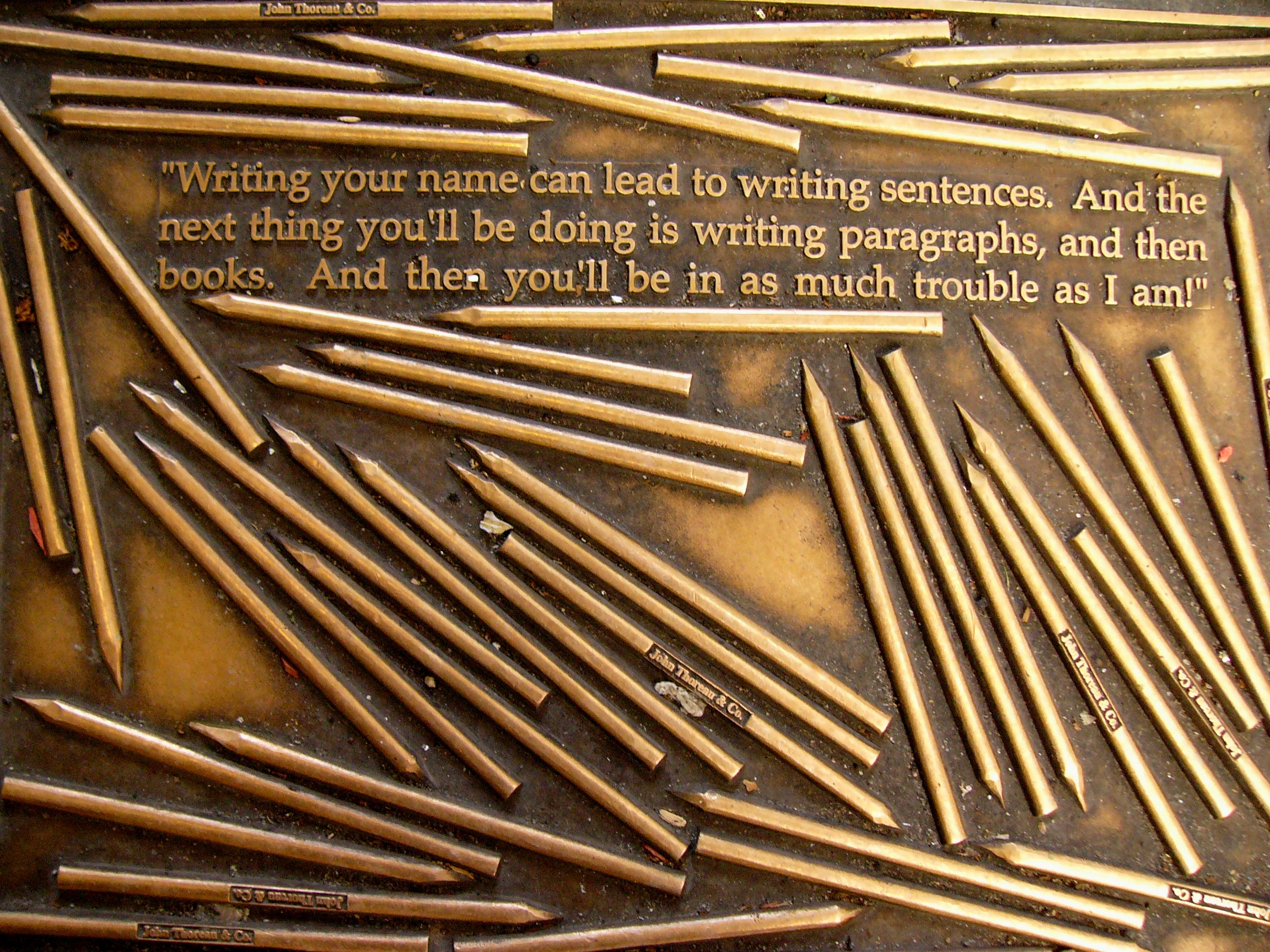
"The only obligation which I have a right to assume, is to do at any time what I think right."
The quote of from "Resistance to Civil Government," by Henry David Thoreau. He wrote of the problems with government as it existed, and his reasons for rejecting it, and his belief that other people should reject it also... and that government needed to be improved.
Reading this piece lights a fire under me, but it's one I can't quite identify or grasp. I'm assuming this is the way many people feel about the general state of things... that there are things which we have an ardent disapproval of, that we'd like to see changed, but we haven't the slightest idea where to begin. Thoreau spoke to people like me, and insisted that we must resist and actively try to change things, rather than sitting around accepting them the way they were, and waiting for someone else to change them.

I find myself disturbed, in fact, by the perplexity I feel in not knowing where to begin. It feels a little hopeless to hope for some of the shitty things in the grand scheme of the world to get any better... for people to become better people... for history to finally start making future generations proud. I've never been very active in any kind of "movement." I've never fervently stood up for something that I believe in, or against something I don't believe in. I wonder if I must grow a bit more of a backbone, or if I should just go along the way I have been, and lean more toward Emerson's suggestions for improving within myself... relying on myself.
Emerson himself said in "An Essay" on Henry David Thoreau, "I have repeatedly known young men of sensibility converted in a moment to the belief that this man was the man they were in search of, the man of men, who could tell them all they should do."
Henry David, can you tell me what to do?
Ralph Waldo Emerson: Self-Reliance
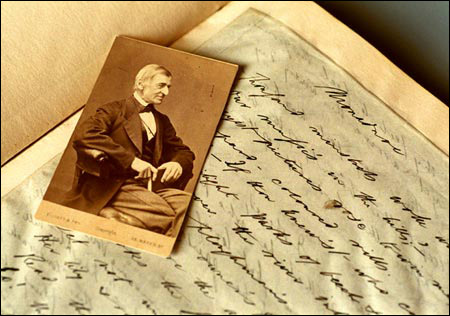 "Society never advances. It recedes as fast on one side as it gains on the other. Its progress is only apparent, like the workers of a treadmill."
- Emerson, "Self-Reliance"
"How I shall henceforth dwell on the blessed hours when, not long since, I saw that benignant face, the clear eyes, the silently smiling mouth, the form yet upright in its great age -- to the very last, with so much spring and cheeriness, and such an absence of decrepitude, that even the term venerable hardly seem'd fitting."
-Walt Whitman, "By Emerson's Grave"
The first quote above is from Ralph Waldo Emerson's "Self-Reliance," a piece full of wisdom on the importance of striving to be an individual, and of NOT conforming to society's expectations. The second quote is Whitman, speaking about Emerson. The rest of "By Emerson's Grave" can be found here.
Emerson's quote makes me think about all I've been reading about American history, and the fact that textbooks keep trying to hammer such B.S. into the minds of young people, saying that this country keeps getting better... that the U.S. only advances and progresses positively, and that, as Robert Loewen put it in so many words, things just "happen" in history... Nobody ever really does anything wrong. In a peaceful manner, the Emerson quote points out that there will always be an ebb and flow, or that perhaps the law of society is like the law of conservation of energy... It is neither created nor destroyed, but merely changes form. But more than making me think about American history, Emerson's "Self-Reliance" makes me think about the importance & greatness of individualism.
I love Whitman... So I knew I might also dig Emerson, since I always hear about how much he influenced Whitman. Although Emerson can be a little tough to read, I ultimately LOVE what he's saying, and to pick just one favorite quote out of an Emerson piece is like trying to eat just one bite of Key Lime Pie... It just can't be done. "Self-Reliance" is full of quotes, & full of profundity. Almost every sentence could be printed on fancy paper & made into an inspirational wall-hanging or refrigerator magnet, reminding one NOT to be self-conscious, and to speak one's mind at all times, before someone else gets to take credit for your great idea. One could fill a home with Emerson wall-hangings & magnets about the importance of letting one's true self shine through to the outside for all to see. "I must be myself. I will not hide my tastes or aversions." One could have an Emerson quote in his kitchen, where he prepares the morning tea, reminding him that "He cannot be happy and strong until he too lives with nature in the present, above time," so that when he sits to enjoy his tea, he might set aside all modern noise and disturbances and simply enjoy his tea, in blissful silence. And when one has had a rough day, in which the world seemed ready to pounce negatively on his every idea, he could remember that Emerson said "To be great is to be misunderstood."
And when her family and friends all seem to think she's making the biggest mistake of her life, while she knows in her gut that it's the right thing for her to do, she can rest easy knowing that Emerson knew the feeling long before she did, because "you will always find those who think they know what is your duty better than you know it" and "the great man is he who in the midst of the crowd keeps with perfect sweetness the independence of solitude."
Maybe I should've just made a list of the Emerson quotes that spoke to me... therefore piecing together a complete Key Lime pie to display to the world in all its beauty and deliciousness. Or maybe that's exactly what I've done, to some extent. And maybe it's not the most perfect pie, or it doesn't look like all the other Key Lime pies, but that doesn't really matter, now does it.
Harriet Jacobs: Incidents in the Life of a Slave Girl
 "These God-breathing machines are no more, in the sight of their masters, than the cotton they plant, or the horses they tend."
The narrator in Harriet Jacobs' Incidents in the Life of a Slave Girl is recalling that even though her grandmother has devoted her "long and faithful service" to her master's family, she is still nothing to them but a piece of property.
After reading Frederick Douglass' Narrative of the Life of an American Slave, Jacobs' story seemed somewhat tame, and less shocking, perhaps. While her life as a slave was by no means easy, it seems that it was less harsh than that of Douglass. In fact, she admits to having it easier than many slaves of her time. She claims never to have gone hungry, or to have been beaten too terribly or worked incredibly hard. Still, her life was unfair. She was owned as property by another human being, and struggled to live a "virtuous" life and to gain her freedom, all the while being perversely pursued and verbally abused by her master, "Dr. Flint." And she struggled and suffered to keep her children safe and attempt to gain their freedom.

I try to imagine her, a young mulatto woman, who I guess must've been physically beautiful... irresistible to her master and to other men mentioned in her accounts. And on top of her beauty, she seemed to be strong-willed, relatively speaking. She stood up to Flint when he tried to claim rights to her, even though he beat her for it. And what was it about her that made Flint keep pursuing her, and even apologizing to her and promising not to hit her again (but not keeping his promise)? What stopped him from simply raping her and beating her senseless like the white men in the other story? Was he a better man? It doesn't seem so.
It seems there was a certain appeal, aside from possible physical beauty, for Flint. He wanted her, and she refused him outright, instead of bowing down and begging for mercy. I wonder if it could've been a case of Flint liking the chase. It may be absurd to assume so, since this wasn't a regular game of "courting" between two free people. And I doubt Jacobs was intentionally playing such a game with him. She did seem aware of a certain sexual "power" she had over Mr. Sands, though. I wonder if she was aware of any such power over Flint.
It seems only natural that there were sexual situations between black slaves and white owners. After all, the slaves were human, sexual beings, and with the immense sexual oppression of the time, there was bound to be consentual as well as non-consentual sexual acts between white men and black women. I wonder how prevalent other sexual situations were. I wonder how many white women engaged in sexual affairs with black slaves, and how many homosexual encounters there were.
I guess the big difference between the narratives of Douglass and Jacobs is that of gender, but it doesn't seem as simple as that. One wouldn't read the two narratives and conclude that either male or female slaves had it any easier than the other, since it was obvious in Douglass that women were severely beaten and treated harshly just as men were. Jacobs appears to have had a better situation all around, at least physically, but I wonder if it's a true account. I wonder if she downplayed events in order not to go overboard and scare away her intended readers.
The genres of the two are argued by critics to be different as well, although the genre of Jacobs' Incidents seems to be widely argued on its own. Carolyn Sorisio is mentioned in this article as looking at Incidents "in terms of both the slave narrative and the sentimental domestic genre and concludes that Jacobs' story—which, Sorisio contends, focuses most heavily on the issue of identity and the conception of self—cannot fit into either of the genres Jacobs has used to tell it."
Frederick Douglass: Narrative of the Life
 "...they would make the dense old woods, for miles around, reverberate with their wild songs... They told a tale of woe... they were tones loud, long, and deep; they breathed the prayer and complaint of souls boiling over with the bitterest anguish..."
Frederick Douglass recalls the songs he heard his fellow slaves singing as they made their way to the Great House Farm.
I'm currently enrolled in a class at SJSU called "Worlds Of Jazz," and have learned a bit about the roots of blues and jazz music. I've learned about "field hollers" and "work songs," and while there's nothing satisfying in learning of the wretched lives of these poor slaves, I find a certain satisfaction in the way things always seem to "tie together" in my studies as an English major. In literature classes and jazz history class, I'm learning more about history than I've ever learned in my life... and it's affecting me more than any other "history" I've ever read before. And while Douglass painted an incredible portrait of the intense hardships of slavery, what better way to express such hardships than with the mention of song, and music!
History is most effectively expressed in this manner: through literature and art, rather than monotonous writings that lack any real emotion, such as the writing in America's history books. And as I'm learning from Robert Loewen in Lies, those history books aren't even accurate, which I guess on some level, maybe I've suspected all along, just as many other Americans have, at least subconsciously.

All my life, I've heard mention of slavery, and how it was an unfortunate thing, and how we're so glad it no longer exists... but I've never truly learned about it until recently, when I've been able to read first-hand, emotional accounts of it through authors such as Booker T. Washington and Frederick Douglass, and indirect accounts through W.E.B. DuBois and Harriett Beecher Stowe. Literature of a particular time period is so much more effective than a history book! And it's all at once liberating and gut-wrenching to learn the truth about such things.
The following is a quote from a review on Amazon.com by a high school student who read the "Narrative of the Life" by Douglass: "He made me feel like I was there with him, witnessing the horrors of the system. Douglass also presented himself as a reasoned, rational figure. His tone was dry, and he did not exaggerate. He was capable of seeing both sides of an issue, even the issue of slavery. This gave his narrative an objective view that made it very valuable to the abolitionist movement." While this is a fairly simple statement about the the "Narrative," it's fitting, since I wish I had been presented with such literature when I attended high school, instead of all the forgettable texts I read for all those years.
Edgar Allan Poe: The Fall of the House of Usher
 "...with an utter depression of soul which I can compare to no earthly sensation more properly than to the after-dream of the reveller upon opium--the bitter lapse into common life--the hideous dropping off of the veil."
Poe is describing, in "The Fall of the House of Usher," the feeling of doom & gloom he feels as he comes upon the house. Although he can't explain why, he feels a foreshadowing of dark things to come.
While the quote above is not necessarily the most interesting, the mention of a "veil" did turn on a light bulb in reference to this week's other selection. But that's not why I chose the quote. I chose it because it's one that takes me back to the Poe I learned of in high school, years ago. I remember reading Poe, and deciding I loved Poe... because he was dark,unusual, and grotesque, and he used big, impressive words. I remember reading "The Raven," and "The Pit and the Pendulum," but not much more, but still fancying myself a big Poe fan for years to come. I never truly knew any Poe, really. Admittedly, this is the first time since high school that I've looked at even another word of Poe. It's true that I did love Poe... but I merely loved the idea of him. He seemed to be one of the bad boys of literature, and I was intrigued. I even chose to refer to Poe when I was asked to re-write a popular fairy tale in the style of a famous author. I wrote a story called "A Wolf, Two Pigs, and I," and used as many big words as I could find in my thesaurus, and made the "Three Little Pigs" into a grotesque horror story.
 I'm still intrigued by Poe today, but for different reasons, I suppose. He's still the dark & mysterious author I recall, but the "bad boy" part of him is not as impressive as it used to be. Now I'm simply interested in his writing, and why he did it, and what it's made of. The quote above, which mentions opium, is what I remember of him... I remember a teacher telling the class that Poe was apparently a little loony, and that it could be attributed to his use of opiates and excessive alcohol. Aside from that, she didn't have much more to say about him, and she seemed a little worried that I claimed to like him so much.
As for "The House of Usher," I found myself re-reading several sentences and paragraphs, finding that I easily trailed off, or got lost in his wordiness (This could also be attributed to other preoccupations in my own life), but once I finally got through the story, I did enjoy it. Poe paints an incredibly detailed scene, and I believe if I saw a well-made movie based on the story, I would get goose-bumps, etc. But the extensive vocabulary that used to impress me, I now find unnecessary, and tend to enjoy more succinctly written fiction.
As this article states in reference to Poe's most widely read pieces, "For the novice reader, these favored texts offer easy (but still challenging) access to Poe's most exemplary writing, entry into his uniquely terrifying world, and intriguing connections to facets of their author's tragically disordered life," the article also points out that readers may also be "tempted to stop here and neglect the breadth and the depth of Poe's contributions to Western Literature." As an English major, I'll make a plan not to do the latter, and make a point to explore more of his Poe's contributions.
Nathaniel Hawthorne: The Minister's Black Veil
 "Its gloom, indeed, enabled him to sympathize with all dark affections."
The narrator in "The Minister's Black Veil" discusses the effect Father Hooper's black veiled face has on the his parishioners, and in the quote above, describes the effect the veil has on Hooper himself.
Hawthorne's notoriously ambiguous style makes it difficult to understand exactly what was intended by this story, and leaves its intended moral(s) open to interpretation One might assume that as a man of God, Mr. Hooper feels a responsibility to his parishioners to make a bold statement out of his own life by donning this mysterious black veil. He is perhaps attempting to stir a certain dark thoughtfulness in them by subtly asking them to think about their own metaphorical "veils" which hide their true inner selves from even their closest family members and friends. By wearing the veil, he ultimately isolates himself from any kind of love or closeness with any other human being, which he is perhaps trying to say everyone does by hiding their deepest secrets within themselves. What's difficult to understand is why Hooper would suddenly make the decision to wear the veil, and why he'd continue to wear it for eternity. One may speculate that Hooper himself had committed some horrible sin, which he decided he must keep hidden forever, and that the veil was a symbol of this.
Personally, as someone who's not sure about the existence of an omniscient being casting judgement over humankind, it's tough to understand why anyone would take on such a ridiculous "burden" as this. It seems simply absurd. Who does this man think he is, trying to teach a lesson to the world for the rest of his life? Or why, if there is a just God, would Hooper not be forgiven for whatever terrible sin he has committed? And from a psychological standpoint, while I think it's good to purge one's sources of shame and insecurity-- to just let it all out sometimes-- I don't think it's always a great idea to purge them onto the people we love. Sometimes the best sounding-board for such things is an impartial party, such as a psychologist. I believe there are things inside all of us, dark or not, that the world does not need to see, and that perhaps we should be selective about who may or may not see these things.

I vaguely recall reading this story as a kid, or having it read to me, but I don't remember at what age, or whether it was supposed to teach me some sort of lesson. It would be interesting to recall the context in which I heard or read it, since it likely came from some "good Christian" teacher in small-town northern Michigan, who thought he or she might be teaching the class some kind of lesson about sin. Who knows?
In a summary at this website, it is stated that "The minister's refusal to tell his congregation why he wears the veil or to remove it for Elizabeth shows that he suffers from the sin of superiority; he believes he is conscious of a truth that everyone else refuses to acknowledge." That's absolutely the way I see it, and I wonder if somehow Hawthorne is being critical of the impact religion had on people of the time. I can't quite put my finger on this one, but perhaps the ridiculousness of Hooper's actions is what Hawthorne was highlighting. I'm not sure if I believe that or not, but I suppose it's a possibility.


